
AI in Drug Development: From Discovery to Strategic Advantage
- Home
- Blog Standard
- Insights Corner
- AI in Drug Development: From Discovery to Strategic Advantage
Insights Details
Month: August 26
Tags: AI in Drug Development, AI in Drug Discovery, Artificial Intelligence, Generative AI, Pharmaceutical R&D, Drug Discovery, TechBio, AI/ML, Clinical Development, AI Governance, AI Regulation, AI-Powered Drug Design, Pharmacovigilance, Pharma Innovation, Future of Drug Development
Let’s Work Together for Development
Call us directly, submit a sample or email us!
Business Address
First Floor, B-66, Sector 63,
Noida, UP, India-201301
Noida, UP, India-201301
Connect With Us
Call us: +91 87500 88882
bd@octavusconsulting.com
bd@octavusconsulting.com
Working Hours
Mon - Fri: 10.00 AM - 07.00 PM
Holidays : Closed
Holidays : Closed
About topic:
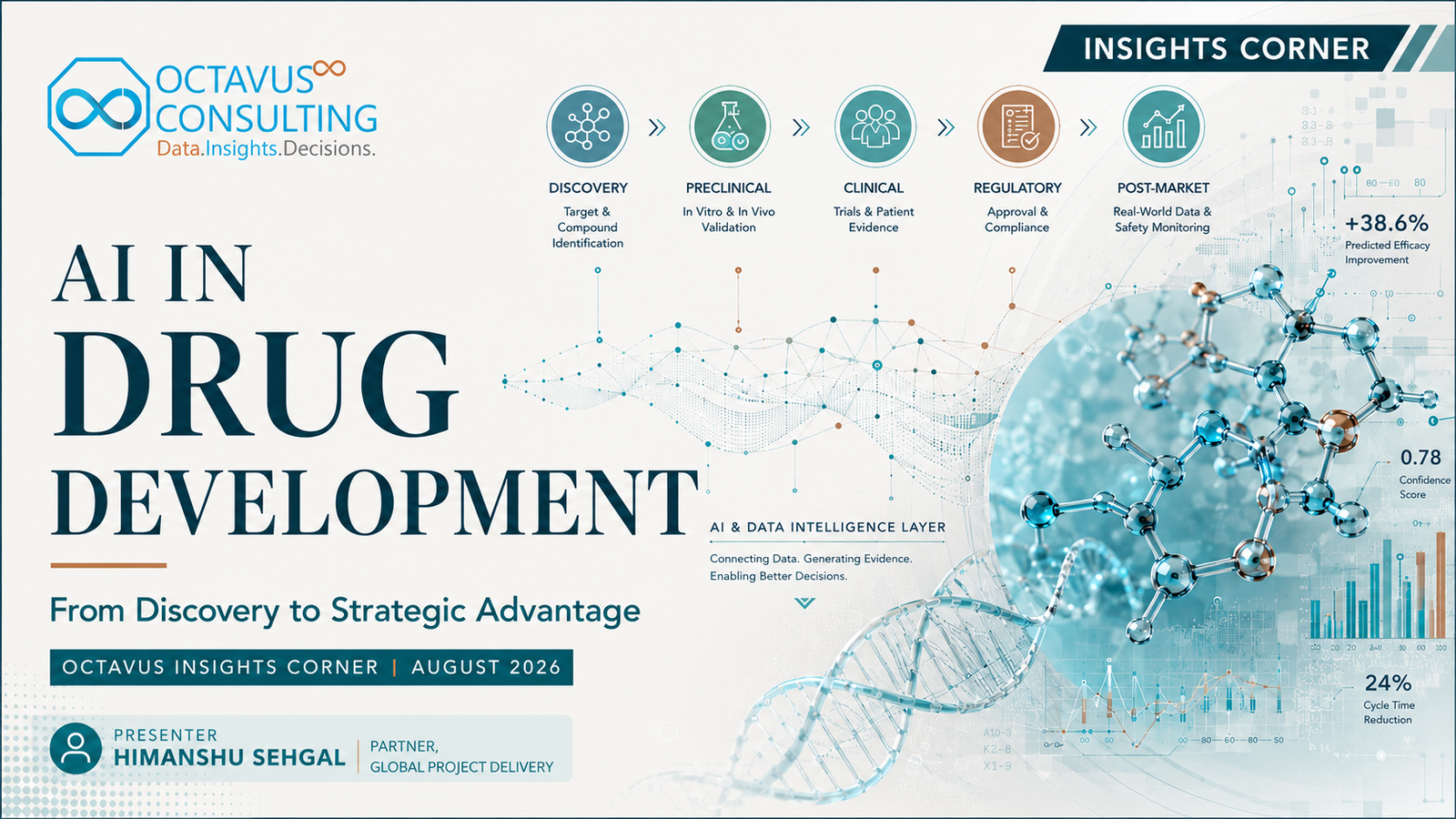
This edition examines AI’s evolution from a discovery tool into a decision-making layer across the drug-development lifecycle—from target identification and molecule design to clinical trials, regulatory submissions, and post-market surveillance. By integrating multi-omics, clinical, and real-world data, AI is enabling faster and more data-driven R&D decisions, while generative AI, foundation models, quantum computing, and lab automation are broadening its applications.
Regulators are also establishing frameworks for responsible adoption. FDA and EMA initiatives around Good AI Practice, risk-based validation, transparency, human oversight, and lifecycle management are making regulatory readiness essential for AI-generated evidence.
Investment remains strong, with approximately $29.2B deployed across 437 AI-enabled drug-development funding deals since 2021, particularly in oncology and AI/ML platforms. Although the market is growing rapidly, it remains fragmented.
Ultimately, leaders will be companies that combine proprietary data, validated AI models, experimental and clinical evidence, automated infrastructure, and robust governance—demonstrating tangible improvements in development timelines, decision quality, and patient outcomes.
AI in Drug Development: From Discovery to Strategic Advantage

Highlights:
The AI-in-drug-development market is projected to expand from approximately $6.5B in 2026 to $35.5B by 2035, representing a 20.7% CAGR. Oncology remains the leading therapeutic area, Asia-Pacific is the fastest-growing region, and the fragmented market leaves the top five vendors with only ~11.8% combined share
AI is being deployed across the full drug-development lifecycle, from target discovery and molecule design to trial optimization, regulatory evidence generation, and pharmacovigilance. Insilico Medicine’s Rentosertib demonstrates accelerating validation, progressing from target discovery to a preclinical candidate in 18 months and subsequently entering Phase 3 trials in China
Regulatory expectations are becoming more defined: The FDA and EMA jointly released 10 Good AI Practice principles in 2026, while the FDA introduced a seven-step AI credibility framework focused on risk-based validation, transparency, human oversight, and lifecycle monitoring
Investment and partnering activity remain strong, with $29.24B invested across 437 funding deals and 1,100 partnering/licensing transactions worth $174.8B during 2021–2025. Sustainable advantage will favor companies combining proprietary data, validated models, automated experimentation, FAIR data infrastructure, and regulatory-ready closed-loop “Design → Test → Learn → Redesign” workflows
Interested in the presentation? Download Here
Interested in the presentation? Download Here

Prashant Sharma, Research Analyst, known for his professional skills in research and analytics, with a strong analytical mindset and proactive problem-solving. With extensive experience, he specializes in secondary research, pipeline analysis, monitoring, and data analysis, contributing effectively across diverse projects and domains