
Companion Diagnostics: Connecting Drugs, Diagnostics and Patient Access
- Home
- Blog Standard
- Insights Corner
- Companion Diagnostics: Connecting Drugs, Diagnostics and Patient Access
Insights Details
Month: September 26
Tags: Companion Diagnostics, CDx, Precision Medicine, Precision Oncology, Biomarker Testing, Molecular Diagnostics, In Vitro Diagnostics, IVD, Personalized Medicine, Drug Development, Clinical Trials, Biomarkers, Next-Generation Sequencing, NGS, Liquid Biopsy, Genomic Profiling, Diagnostic Testing, Targeted Therapies, Companion Diagnostic Market
Let’s Work Together for Development
Call us directly, submit a sample or email us!
Business Address
First Floor, B-66, Sector 63,
Noida, UP, India-201301
Noida, UP, India-201301
Connect With Us
Call us: +91 87500 88882
bd@octavusconsulting.com
bd@octavusconsulting.com
Working Hours
Mon - Fri: 10.00 AM - 07.00 PM
Holidays : Closed
Holidays : Closed
About topic:
This edition examines companion diagnostics (CDx) as they move from a regulatory checkbox to a strategic pillar of precision drug development. The FDA now lists 168 biomarker-drug pairings linked to approved diagnostic tests, and the CDx market is projected to grow from $9.37B in 2026 to $28.75B by 2035, a 13.3% CAGR, as targeted therapies and biomarker-defined patient populations expand. Broader molecular profiling NGS, comprehensive genomic profiling, and multiplex platforms is replacing sequential single-marker testing, while liquid biopsy, MRD monitoring, AI-assisted diagnostics, and decentralized testing are emerging as the next wave of applications.
Regulators on both sides of the Atlantic are reshaping the pathway to market. FDA and EMA policy shifts between 2024 and 2026 including a proposed Class III-to-Class II reclassification for eligible oncology nucleic acid-based CDx and updated EMA consultation guidance are aimed at streamlining development without loosening safety and effectiveness standards.
Despite this momentum, adoption still depends on closing evidence, access, and implementation gaps. Regulatory approval does not guarantee reimbursement, real-world payer denials show that clinical utility and medical necessity, not FDA clearance alone ultimately determine patient access, and coverage disparities remain especially pronounced outside the US.
Looking ahead, CDx is evolving toward longitudinal, AI-enabled, multi-analyte testing. Scale, partnerships, and evidence generation are becoming the key competitive differentiators, favoring integrated pharma-diagnostic ecosystems and established platform players such as Foundation Medicine and Guardant Health over smaller, single-product entrants.
Companion Diagnostics: Connecting Drugs, Diagnostics and Patient Access
Highlights:
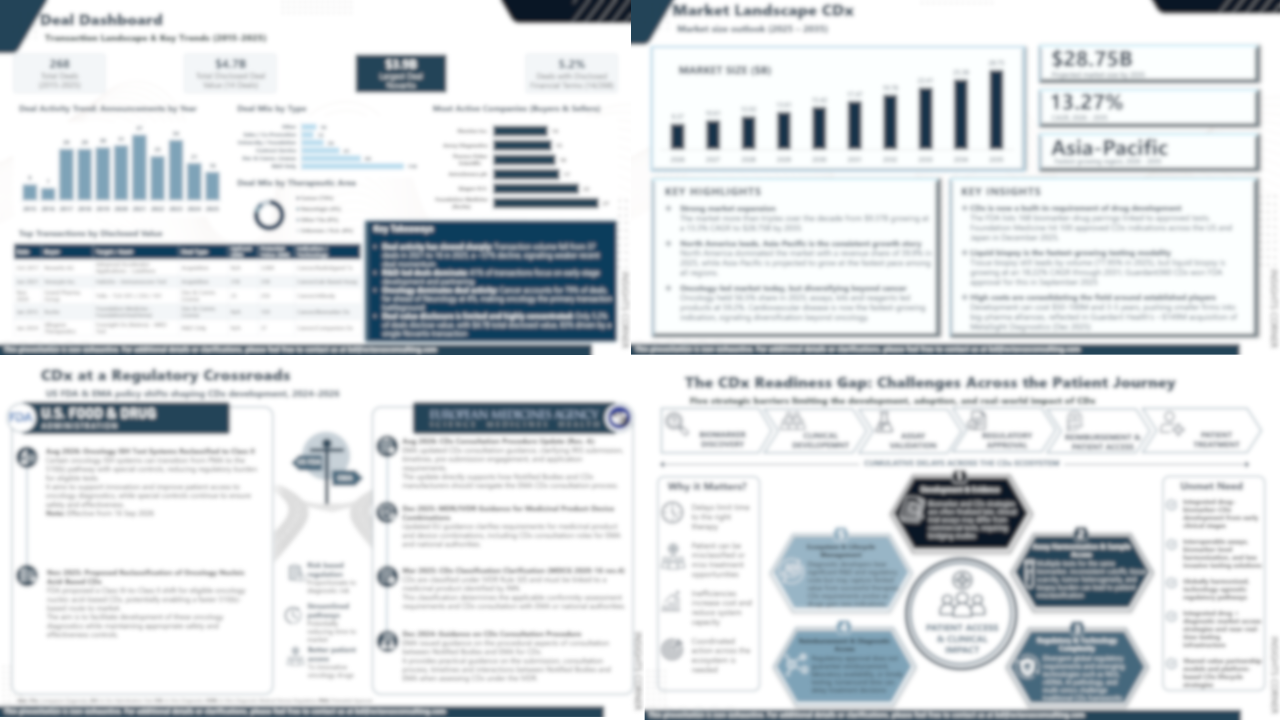
CDx is entering a high-growth phase: The global market is projected to more than triple from $9.37B in 2026 to $28.75B by 2035 (13.3% CAGR), led by North America while Asia-Pacific grows fastest. Oncology remains dominant, but cardiovascular applications are expanding rapidly
Testing is becoming broader and more longitudinal: CDx is shifting from single-marker tissue testing toward NGS, comprehensive genomic profiling and liquid biopsy, with liquid biopsy projected to grow at 18.22% CAGR through 2031 and emerging applications in MRD and treatment monitoring
Regulation is evolving toward greater efficiency: FDA and EMA changes are creating more streamlined, defined CDx pathways, including proposed FDA reclassification of eligible oncology nucleic-acid CDx and updated EMA consultation guidance in 2026
Evidence and ecosystem scale are becoming critical: Despite 268 CDx-related deals since 2015, activity declined from a 2021 peak of 37 to 16 in 2025, while $13B across 93 funding rounds has concentrated around established platform players such as Foundation Medicine and Guardant Health
Interested in the presentation? Download Here
Interested in the presentation? Download Here

Priyanka Thakur, a Pharma Analyst with expertise in primary and secondary research and a strong analytical approach, specializes in tracking clinical developments, emerging therapies, market trends, and competitive activity across the life sciences industry, contributing effectively to diverse projects and therapeutic areas.