
Gene Therapy Landscape From the World of CGT (Part-2)
- Home
- Blog Standard
- Insights Corner
- Gene Therapy Landscape From the World of CGT (Part-2)
Insights Details
Month: May 26
Tags: Gene therapy, Cell and gene therapy, In vivo gene therapy, Ex vivo gene therapy, AAV vectors, Non-viral delivery, CRISPR, Gene therapy market trends, Advanced therapies insights, Rare diseases, Healthcare investments, Biopharma deals, Regulatory Insights, Insights corner, AI
Let’s Work Together for Development
Call us directly, submit a sample or email us!
Business Address
First Floor, B-66, Sector 63,
Noida, UP, India-201301
Noida, UP, India-201301
Connect With Us
Call us: +91 87500 88882
bd@octavusconsulting.com
bd@octavusconsulting.com
Working Hours
Mon - Fri: 10.00 AM - 07.00 PM
Holidays : Closed
Holidays : Closed

About topic:
In this video, we take a closer look at how gene therapy is redefining treatment by targeting the underlying genetic cause of disease instead of just relieving symptoms. It is gaining real‑world relevance in rare diseases, blood disorders, eye diseases, neuromuscular conditions, and selected CNS indications, where a single intervention can offer long‑lasting benefit. The field is shifting from a one‑size‑fits‑all model toward a specialized toolbox, using platforms like AAV, lentiviral vectors, CRISPR, and base editing, with AAV remains a critical workhorse for in vivo delivery making vector choice a central strategic decision for companies. At the same time, gene therapy faces important challenges, including ultra‑high costs, immune responses, and lingering uncertainty about long‑term durability and real‑world outcomes.
Beyond the science, gene therapy is now a serious business and execution game, with multi‑billion‑dollar funding and deal activity concentrated around late‑stage and approved assets in oncology and rare diseases. However, success is no longer defined only by impressive clinical data; real winners are those who can secure vector supply, scale up manufacturing, ensure CMC comparability, manage immunogenicity, and design feasible redosing strategies. Looking ahead, the future frontier includes a shift toward in vivo gene editing, safer non‑viral delivery systems, AI‑driven design, and a push into broader indications with greater focus on access and equity. With more than 160 new trials annually by 2025 and flexible frameworks from the US FDA, EMA, and ICH de‑risk development and support wider adoption of next‑generation gene therapies.
Gene Therapy Landscape From the World of CGT (Part-2)
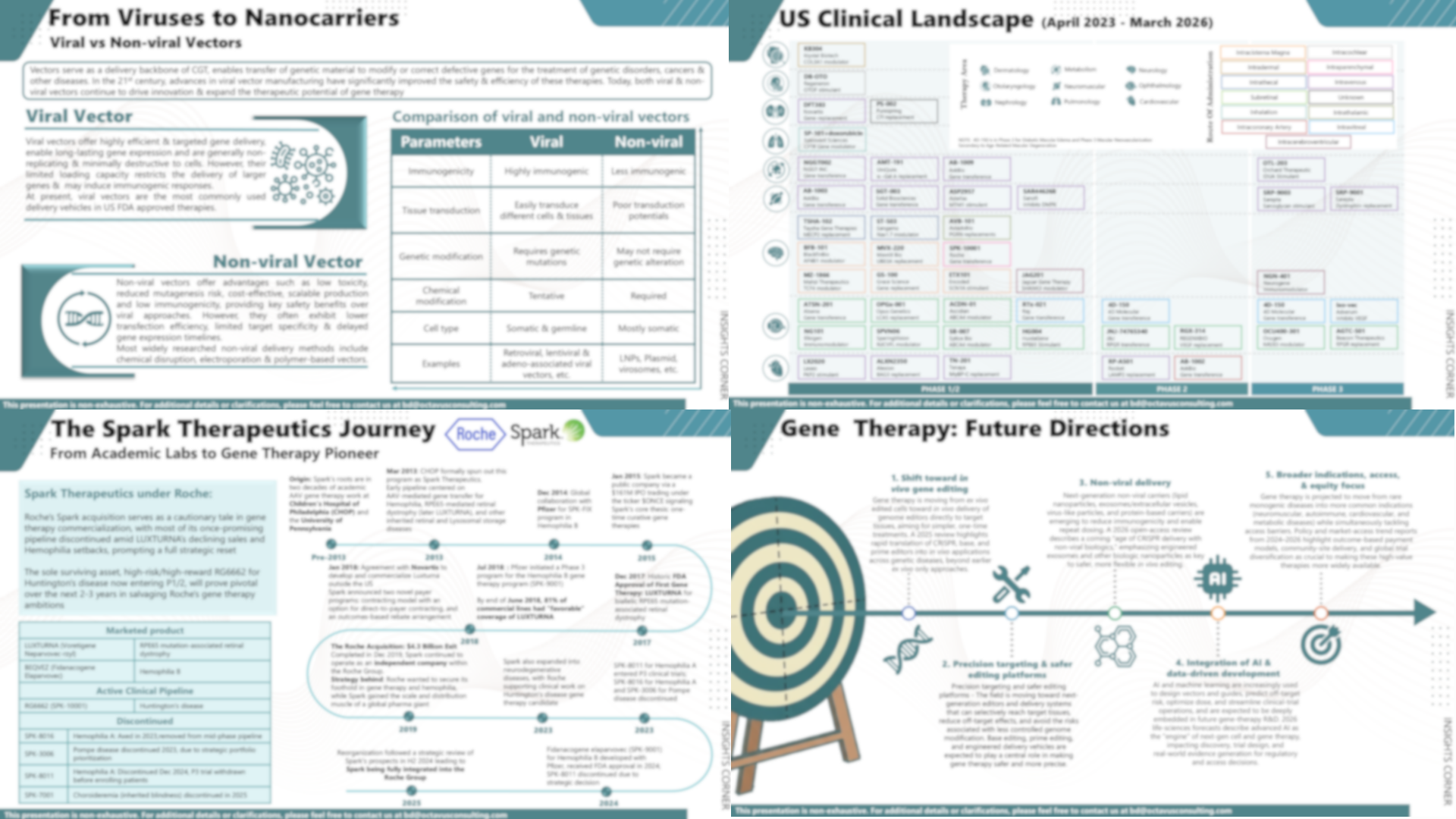
Highlights:
Gene Therapy Has Evolved From High Risk Experiments Into A Strategic Therapeutic Platform, With Clear Technology Archetypes Emerging Across In Vivo Vs Ex Vivo Approaches, AAV Vs Non Viral Delivery, And Gene Editing Modalities (CRISPR, Base/Prime Editing)
The Global Gene Therapy Market Is Projected To Grow From About $8.9B In 2025 To $51.5B By 2035 (~19% CAGR), Supported By Strong Funding (24B Across 154 Rounds In 2025) And $25.3B In Deal Value, Skewed To Late Stage And Approved Assets
Clinical And Regulatory Momentum Is Strong, With >160 New Trials Annually By 2025, An Expanding Pipeline Of 2026 Milestones (Multiple PDUFAS And Pivotal Readouts), And Updated FDA/EMA/ICH Guidance's On Flexible CMC, Rare Population Trial Design, Expedited Pathways, And Long Term Real World Data Capture
Despite Promise, Execution Is The Main Bottleneck: Vector Supply, CMC Comparability, Immunogenicity, Redosing Limits, Manufacturing Scale Up, Ultra High Prices, And Payer Pushback Are Reshaping Winners And Losers, As Illustrated By Spark Therapeutic’s Post Acquisition Reset Under Roche
Interested in the presentation? Download Here

Nancy Shivhare is a Pharma Analyst specializing in secondary research and conference planning for major industry events (ASH, JPM), with expanding expertise in competitive intelligence, news summarization, and investor relations coverage. Recognized for rapid adaptability and continuous skill development in dynamic pharmaceutical and biotech environments