
RAS Inhibitors: The New Frontier in Precision Oncology
- Home
- Blog Standard
- Insights Corner
- RAS Inhibitors: The New Frontier in Precision Oncology
Insights Details
Month: October 26
Tags: RAS Inhibitors, KRAS Inhibitors, Precision Oncology, Daraxonrasib, Revolution Medicines, Zoldonrasib, Divarasib, Olomorasib, KRAS G12C, KRAS G12D, KRAS G12V, RAS(ON), Pancreatic Cancer, Non-Small-Cell Lung Cancer, Colorectal Cancer, Targeted Therapies, Clinical Development, Competitive Intelligence, Oncology Pipeline, Biotech Strategy, Octavus Insights Corner
Let’s Work Together for Development
Call us directly, submit a sample or email us!
Business Address
First Floor, B-66, Sector 63,
Noida, UP, India-201301
Noida, UP, India-201301
Connect With Us
Call us: +91 87500 88882
bd@octavusconsulting.com
bd@octavusconsulting.com
Working Hours
Mon - Fri: 10.00 AM - 07.00 PM
Holidays : Closed
Holidays : Closed
About topic:
Once considered “undruggable,” RAS has become an important frontier in precision oncology. The development of direct KRAS G12C inhibitors established a foundation for a broader wave of therapies targeting additional mutations, active-state RAS, and multiple RAS variants. These approaches are expanding the development landscape across pancreatic, non-small-cell lung, and colorectal cancers
In the October 2026 edition of Octavus Insights Corner, we examine how advances in RAS biology are translating into clinical evidence, competitive positioning, and commercial opportunity. The analysis explores daraxonrasib and Revolution Medicines’ broader portfolio alongside emerging inhibitors, protein degraders, combination regimens, and alternative delivery approaches. It also considers the questions that will shape future differentiation: durability of benefit, tolerability, resistance, patient selection, and expansion into earlier treatment settings.
RAS Inhibitors: The New Frontier in Precision Oncology
Highlights:
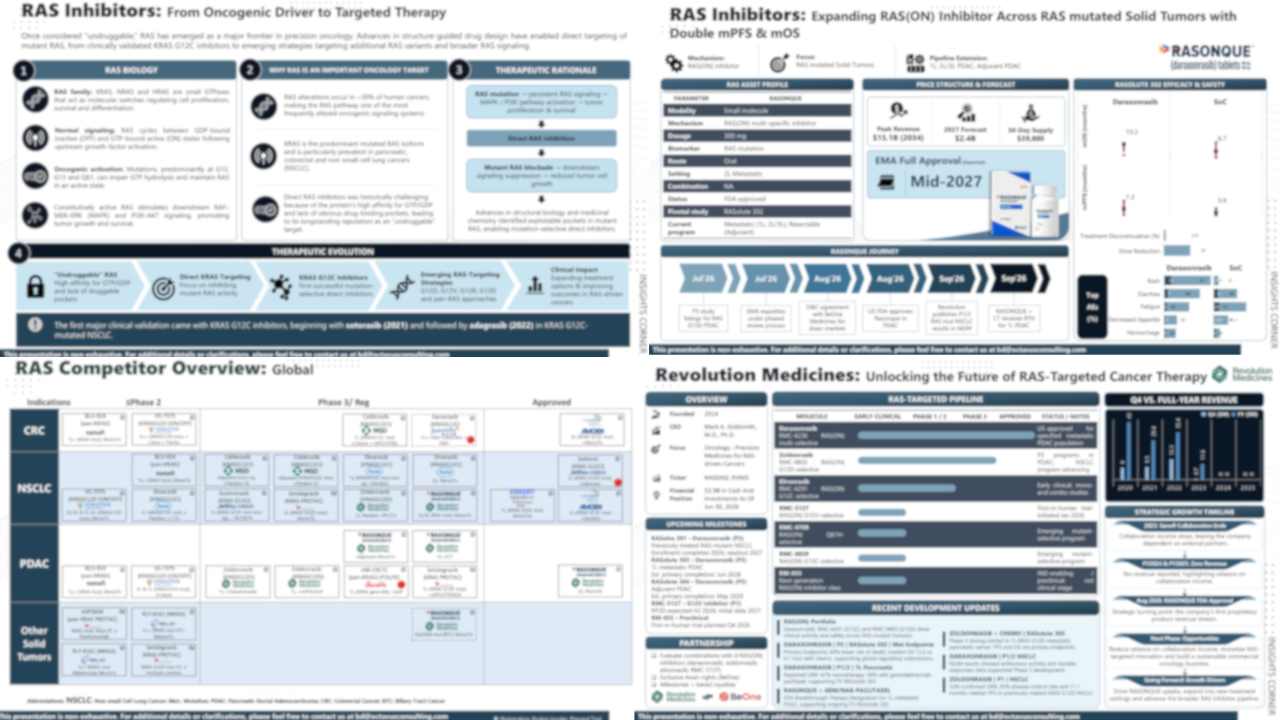
RAS Targeting Is Expanding Beyond KRAS G12C: The field is progressing from the first mutation-selective inhibitors toward KRAS G12D, G12V, and broader RAS-targeting strategies. Differences in mutation coverage, ON/OFF-state targeting, and modality create distinct development opportunities—making it essential to assess each asset within its specific biological and clinical context.
Clinical Evidence Is Raising the Competitive Bar: Daraxonrasib’s randomized pancreatic-cancer results highlight the importance of demonstrating meaningful survival benefit. Meanwhile, emerging combination data provide hypotheses for further development. The distinction matters: encouraging response rates in small, single-arm cohorts do not establish superiority over treatments evaluated in separate trials.
Combinations and New Modalities Could Shape Differentiation: Developers are exploring combinations with chemotherapy, immunotherapy, and other targeted agents, alongside protein degradation and intravenous delivery approaches. These strategies may offer opportunities to deepen response or address resistance, but their value will depend on demonstrated clinical benefit, manageable toxicity, and practical treatment delivery-not mechanistic promise alone.
Commercial Potential Depends on Execution: Investor interest reflects the possibility of building multi-asset, multi-indication RAS franchises. However, theoretical market size is not equivalent to achievable sales. Clinical outcomes, eligible patient populations, treatment duration, competition, pricing, and access will determine how much of the opportunity translates into sustainable commercial value.
Interested in the presentation? Download Here
Interested in the presentation? Download Here

Babli Singh is a Senior Analyst with strong analytical skills and a deep understanding of the biopharmaceutical and healthcare industries. She specializes in monitoring emerging trends and distilling complex information into concise, insightful summaries that deliver clear value and actionable intelligence for a global professional audience.